About fifty years ago, Robert V. Guthrie and I were invited to make special bicentennial presentations at the 1976 convention of the Western Psychological Association in Los Angeles (April 8, 1976). I spoke first on “The Psychology of Induced Helplessness and the Second American Revolution.” I began my speech with a quote from our Declaration of Independence:
“. . .all experience hath shewn, that mankind are more disposed to suffer, while evils are sufferable, than to right themselves by abolishing the forms to which they are accustomed.”
I attempted to explore those areas of psychological inquiry that might help explain this willingness to suffer the slings and arrows of outrageous fortune.

Guthrie titled his presentation, “Even the Rat was White.” He offered an analysis of prior psychological studies that drew racially biased and inaccurate conclusions about Black people. He also introduced Black psychologists who made significant contributions to the field of psychology.
We both received standing ovations from the large gathering. We shook hands and had a rather lengthy conversation after the session. We agreed on the need for significant social change, but we also shared an optimistic vision for a better future. Bob went on to publish a book using that same title. We didn’t meet again until much later when he came to Illinois to teach at Southern Illinois University.

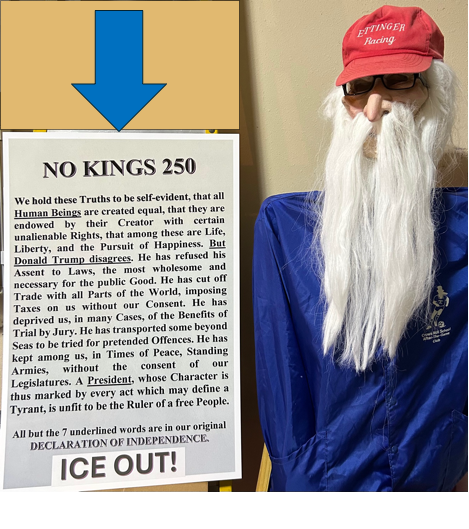
Now that we are about to celebrate the 250th year of our independence, I fear that the optimism shared in our two bicentennial presentations may be at risk. As I reread our Declaration of Independence, I noticed some disturbing parallels between the behavior of the king we were rejecting 250 years ago and that of our current president. I created a poster to commemorate that document and urge my fellow Americans to join the NO KINGS movement. I hope to see you at the next NO KINGS protest.

Dr. Ron Ettinger was a professor in the Psychology department at UIS.
The Observer invites members of the campus community to submit opinion pieces for possible publication. Columns, which are subject to editing, should not exceed 900 words and should address issues of interest to the campus community. Columns can be emailed to [email protected].
![[Mikayla Rodgers speaking on campus in support of striking UIS faculty.]](https://uisobserver.com/wp-content/uploads/2026/04/image001-1-901x1200.jpg)