


As part of a reassessment of the needs of students in central Illinois and the realities of the regional job market, the University of Illinois Springfield plans to launch a new bachelor’s degree in Engineering Technology.
University leaders say the program, approved by the U of I Board of Trustees in March and expected to launch in the fall of 2027 pending final approvals, will combine classroom and laboratory learning with real-world industry experience.
Travis Bland, dean of the College of Health, Science and Technology at UIS, said it is important to distinguish between engineering and engineering technology programs, particularly when comparing UIS’s new program to engineering degrees offered at larger research universities.
“Programs like those at University of Illinois Urbana-Champaign produce engineers, the people who design systems and run theoretical calculations. Our program produces engineering technologists, the people who take those designs and make them work in the real world, programming the automation, managing the construction project or leading the production team,” said Bland.
Employer and Workforce Demand
The degree was developed in response to employer feedback of a shortage of bachelor’s-level engineering technologists. Regional employers such as O’Shea Builders, Hanson Professional Services, Wallace Holland Kastler & Schmitz, the Illinois Department of Transportation, Illinois Department of Natural Resources and the City of Springfield all indicated a lack of mid-level technical applicants.

“We looked at the labor market, listened to employers and found a clear gap. It’s a documented need that our region is asking us to meet,” Bland said.
UIS labor market research supports these concerns. According to Bland, Illinois produces more than 2,000 engineering technology associate degrees each year but only 206 bachelor’s-level completions. In a broader four-state region, Bland said there are approximately 4,136 annual job openings for bachelor’s-level engineering technologists compared to the roughly 1,100 graduates. That is a gap of about one graduate for every four positions.
Transfer Pathways and Student Access
While acknowledging strong engineering technology programs at Illinois State University and Southern Illinois University Carbondale, Bland said UIS’s program is designed to meet needs those programs do not fully address.
The UIS program will include a structured transfer pathway for community college students, a work-based learning model and accessibility for traditional students. Bland said the program is especially important for students from the Capital Area Career Center, which serves 21 school districts across five counties.
“They are already taking introductory engineering courses but currently have no local bachelor’s destination,” Bland said.
Funding and Sustainability
The budget proposal for the new program outlines funding sources and the projected growth of the program as enrollment increases. Funding for the project will not be drawn from existing UIS resources. Instead, the program will receive an advance from the University of Illinois System with the expectation that it will eventually become financially self-sustaining through tuition revenue.
The engineering program will also include the creation of five new positions over its first few years: a director, three faculty members, a program coordinator and an academic advisor.
The program will not require new construction on campus but will instead rely on pre-existing campus features, such as the Orion Lab, other spaces in Brookens Library and local employer facilities.
“The work-based learning model also means that a significant portion of applied learning happens at employer sites through cooperative education placements,” said Bland.
Part of a Broader Program Review
The Engineering Technology program emerged from UIS’s Academic Program and Portfolio Review, which began in 2024 to assess how well the University’s academic offerings align with regional and student needs.
“The portfolio review was a comprehensive look at all of our existing programming, where we need to strengthen and improve, where additional investment is needed and where there are gaps in our offerings,” Bland said.
The Portfolio Review concluded in a report that issued recommendations for the management of academic programs at UIS. Based on a number of criteria, programs received a classification into one of six categories: maintain/enhance, maintain, reform, reform-consolidate, sunset/reform and sunset.
The decision to create a new engineering program comes at a time when the result of the Portfolio Review recommended a number of programs for sunsetting. Sunsetting refers to allowing students currently enrolled in a program to graduate but not enrolling any new students, resulting in the phasing out of the program.
Programs recommended for sunsetting include a minor in Liberal Studies and bachelor’s programs in Theater, Public Policy, Philosophy and Psychology.
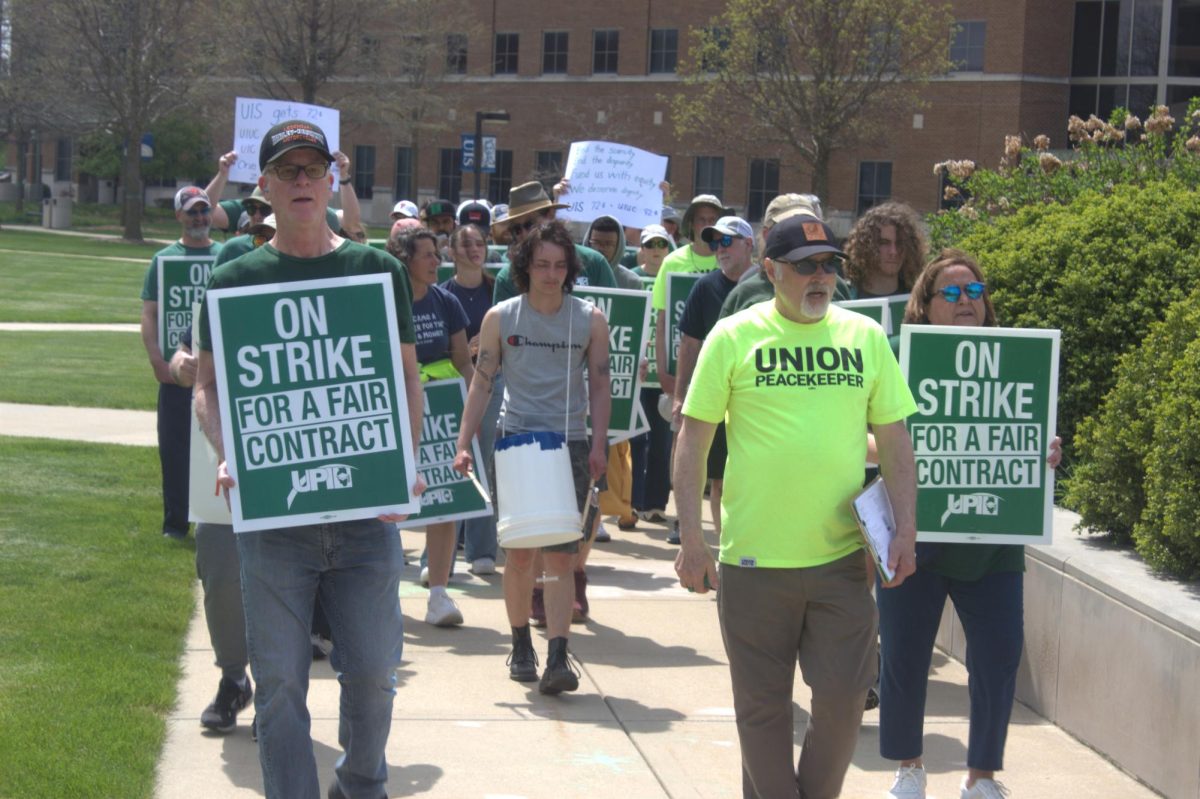








![Theater professor and director of theater at UIS, Eric Thibodeaux-Thompson [left front] and other striking faculty members march around the colonnade on Monday, April 13.](https://uisobserver.com/wp-content/uploads/2026/04/image001-2-1200x799.jpg)