While there is no one definition for the term, factors such as age, time of enrollment, financial or family status, and high school graduation status all contribute to whether someone is considered a non-traditional college student. According to a study from the academic journal Teacher-Scholar, The National Center for Education Statistics found that 74% of college students possess at least one non-traditional characteristic, demonstrating that this population now represents the majority rather than the exception.
The National Center for Education Statistics states that non-traditional students commonly delay enrollment, attend part-time, work full-time, are financially independent, or care for dependents, creating unique structural challenges within systems designed for traditional learners. Non-traditional students bring tremendous resilience and determination into higher education, yet the barriers they face often go unseen.
For non-traditional UIS student Lauren Allen, each day beings long before her college courses do.
“A typical day for me starts early as I get myself and my son ready,” she said. “I spend most of my day teaching and supporting my students, which takes a lot of energy and focus.”
It is only after a full workday that Allen moves her focus to coursework. But her other responsibilities are never far from her mind.
“I usually shift into homework, meetings, or classwork for my own degree. In between, I’m answering emails, planning lessons, and trying to stay organized. I’m working toward my goals and providing for my family,” Allen said.

Allen’s experiences reflect the National Center for Education Statistics’ findings that non-traditional students frequently juggle work, parenting, and academics simultaneously, often without sufficient institutional flexibility.
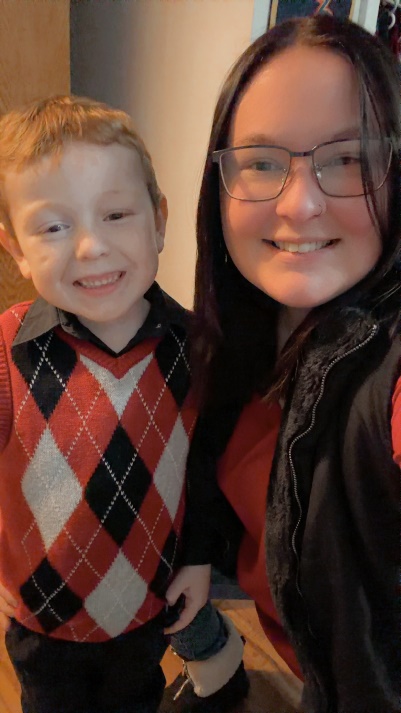
Another non-traditional student at UIS, Amadna Swigert, faces even heavier demands. She works two jobs, one as a kindergarten teaching assistant and another cleaning houses, while raising two children and completing six college courses.
“A typical day for me is pretty hectic. I’m currently working two jobs, and I am a wife and mother of two boys,” Swigert said.
Both Allen and Swigert expressed that they wished to be seen, not as exceptions, but as essential members of the campus community, students whose lived experiences enrich the classroom.
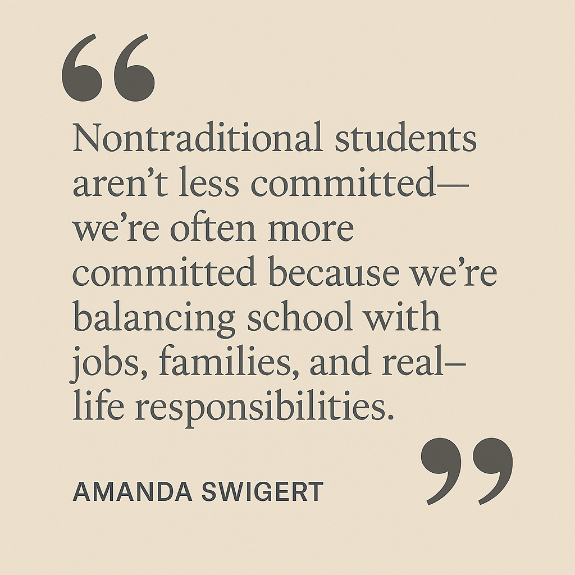
“Non-traditional students aren’t less committed— we’re often more committed because we’re balancing school with jobs, families, and real-life responsibilities,” Swigert said.
Both women described substantial academic pressure. Swigert, who carries a 3.81 GPA, admitted that receiving two Bs made her feel like she had “imploded.”
This intense self-imposed pressure is consistent with a study from Educational Research, which identifies confidence challenges, generational gaps, and limited academic support as common barriers faced by non-traditional students, particularly those returning to school after many years.
Financial pressure is another critical barrier. Allen said that scholarships and grants rarely cover the full cost of living, childcare, transportation, or emergencies. According to the National Center for Education Studies, this is unsurprising: financial independence is a core characteristic of non-traditional students, making them more vulnerable to unexpected expenses and financial instability.
Ella Lawrence, the Director of Financial Assistance Operations at US, said that UIS offers grants, emergency funds, and aid options that many non-traditional students may qualify for. However, the information she provided was individualized to specific cases which illustrates a longstanding challenge: resources may exist, but non-traditional students often struggle to access clear and initiative-taking information about them.
Swigert’s most severe barriers were institutional. When she sought disability accommodations, she described the process as “a nightmare.” Administrative delays forced her to drop courses after the refund deadline, leaving her financially responsible for classes she medically could not complete.
When she requested virtual attendance due to health needs, she was denied. Swigert stated that a professor told her: “Just drop out of UIS and go to the University of Phoenix if you need online classes.”
Rebecca M. Matter, Director of Disability Services at UIS, said that “being a non-traditional student does not affect eligibility” for accommodations. She said that all students must register through MyAccessCenter, upload documentation from a healthcare provider, and then the system notifies her office to initiate the review.
Matter’s response makes clear that while the policy is structurally neutral, the process, which requires documentation, time, and follow-through, may feel inaccessible to non-traditional students already balancing work, childcare, health issues, and academic responsibilities.
Despite numerous obstacles, financial strain, academic pressure, discrimination, and institutional delays, Swigert and Allen remain committed to their education. Their stories reveal a crucial truth: non-traditional students are not simply pursuing degrees; they are striving for stability, upward mobility, and better futures for their families and communities.
Their determination underscores the urgent need for higher education systems to modernize their structures, improve communication, streamline accommodations, and proactively support students with non-traditional circumstances.